Affiliate Disclosure: This article may contain affiliate links. If you purchase through one of these links, DobermanLiving may earn a small commission at no additional cost to you. We only recommend products, gear, and tools we genuinely believe can help Doberman owners.
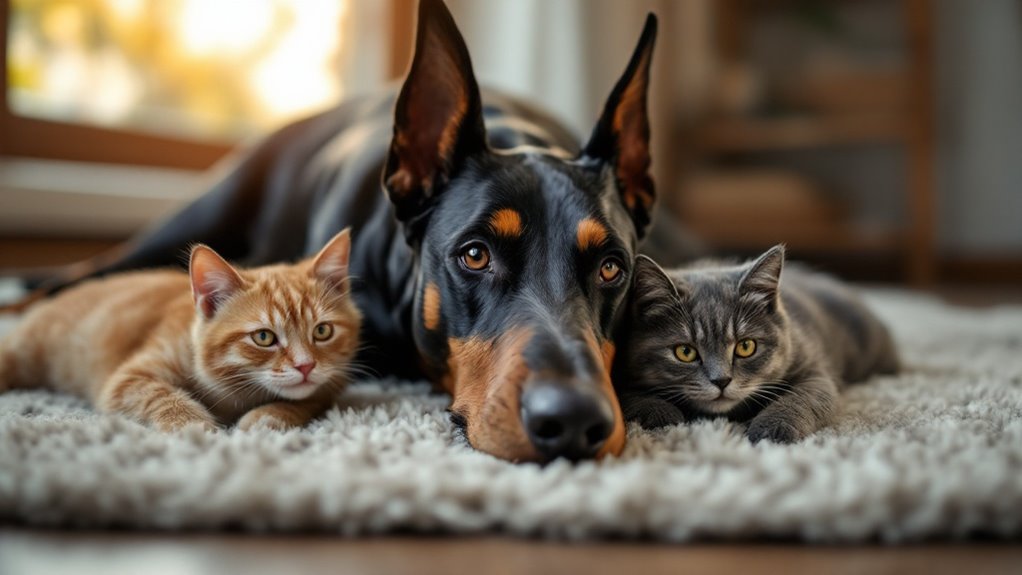
Yes, your Doberman can live with cats, but success depends on management, not breed reputation alone. A 75% cohabitation success rate is achievable through proper socialization, controlled introductions, and consistent boundaries. Whether you’re starting with a puppy or adult dog matters considerably, as does preventing chasing—even one successful chase reinforces predatory instincts and makes cohabitation harder. Plan for leashing, crating during unsupervised periods, and separate outdoor access as permanent safety tools. The goal isn’t friendship; it’s peaceful tolerance and safe coexistence. Understanding the specific steps that prevent chase cycles reveals how realistic this actually becomes.
- Key Takeaways
- Can Dobermans and Cats Actually Live Together?
- Is Your Doberman a Puppy or an Adult? (Why This Matters)
- The Scent-Based Introduction Method
- Gate and Barrier Introductions: Building Comfort Without Direct Contact
- Your First Face-to-Face Meeting: Steps and Leash Control
- Aggression Signs: When to Pause and Back Off
- Stopping the Chase: Why Prevention Now Avoids Disaster Later
- Outdoor Supervision Changes Everything
- Leashing, Crating, and Boundaries for Long-Term Safety
- Cohabitation Without Perfection: What Success Really Looks Like
- Frequently Asked Questions
- Conclusion
Key Takeaways
- Yes, Dobermans can live with cats—approximately 75% achieve acceptable cohabitation with proper management and socialization.
- Success requires preventing chase behavior, consistent training, vigilant supervision, and realistic expectations of tolerance rather than friendship.
- Puppy socialization creates lasting habits; adult introductions need slower protocols due to entrenched prey drives.
- Introduce gradually using scent-swapping, barrier work, and controlled visual meetings before allowing unsupervised proximity.
- Maintain long-term safety through leashing during transitions, separate outdoor access, and permanent cat-safe zones.
Can Dobermans and Cats Actually Live Together?
Most Dobermans can actually live alongside cats when introductions are handled with care and consistency, with surveys indicating roughly a 75% chance of achieving an acceptable or better relationship between the two animals. You’ll find that success depends heavily on how you manage the process, not on breed reputation alone.
A properly socialized Doberman and cat pairing requires patience during initial meetings, controlled environments, and vigilant supervision. The critical factor is preventing chasing, since every chase episode reinforces your Doberman’s prey drive and markedly increases injury risk.
When you introduce them gradually through scent work and barrier meetings before face-to-face contact, you build a foundation for coexistence. With proper management strategies and consistent training, many households successfully maintain harmonious Doberman and cat relationships.
Is Your Doberman a Puppy or an Adult? (Why This Matters)
The age of your Doberman fundamentally shapes how you’ll approach introducing a cat, because puppies and adult dogs bring vastly different developmental capabilities and behavioral histories to the introduction process.
- Puppyhood socialization during the first year creates lasting habits, and early, calm exposure to cats dramatically increases the likelihood of peaceful cohabitation throughout your dog’s life.
- Adult introductions proceed more slowly, requiring cautious, step-by-step protocols because adult Dobermans may have entrenched prey drive or negative experiences that complicate the process.
- Preventing successful chasing in puppies through tethering, x-pens, or gates stops predatory behavior from reinforcing itself into harder-to-change adult patterns.
- Unknown rescue backgrounds demand especially careful barrier work, scent introductions, and professional guidance if your dog shows fixation or aggression.
The Scent-Based Introduction Method
Before you bring your Doberman and cat face-to-face, you’ll want to build familiarity through scent alone, which creates a foundation of calm recognition rather than surprise or reactive behavior.
Start by swapping bedding between their separate rooms—sliding a towel the cat’s slept on under your dog’s door, then rewarding your Doberman with treats and praise when it sniffs calmly—so each animal becomes accustomed to the other’s presence without the intensity of a visual meeting.
Over several days, swap their living spaces entirely so your home carries both scents throughout, making the eventual introduction feel like a continuation of something already familiar rather than a sudden encounter.
Building Familiarity Through Scent
Introducing your Doberman to a cat doesn’t require immediate face-to-face contact; in fact, starting with scent-only exposure creates a safer, less overwhelming foundation for both animals.
This gradual approach lets your dog become familiar with the cat’s presence without the intensity of visual or physical interaction.
- Keep them separated behind closed doors for several days, allowing them to smell each other underneath
- Swap bedding or clothing items between animals to build positive association with each other’s scent
- Reward your Doberman with high-value treats when calmly sniffing the cat’s belongings
- Briefly exchange rooms so each animal explores the other’s space linked to comfort and play
Repeated short scent sessions over multiple days prevent over-arousal and enable gradual habituation, establishing calm responses before you attempt any direct introduction.
Swapping Spaces and Bedding
Building up your Doberman’s comfort with a cat works best when you create multiple opportunities for scent exposure without the pressure of face-to-face meetings, and swapping spaces and bedding accomplishes this by letting each animal investigate the other’s environment at their own pace. You’ll swap rooms for a day or two, allowing your Doberman to explore the cat’s area while the cat examines yours, gradually reducing novelty before any visual contact occurs.
| Introduction Method | Duration | Purpose |
|---|---|---|
| Room swapping | 1–2 days | Scent familiarization |
| Cat-used item placement | Several days | Positive reward pairing |
| Bedding exchange | Overnight sessions | Association building |
Place a cat-used item like a blanket in your dog’s space, rewarding calm sniffing with treats. This reshapes your Doberman’s emotional response, building positive associations that ease eventual meetings considerably.
Gate and Barrier Introductions: Building Comfort Without Direct Contact
Once you’ve established that your Doberman and cat can tolerate each other’s scent, a sturdy see-through barrier—such as a baby gate or tall dog gate—becomes your next tool for gradual desensitization, allowing both animals to see and smell each other while maintaining a protective distance that reduces risk and prevents the intensity that sometimes comes with direct contact.
Start barrier introductions with short sessions (5–10 minutes) several times daily, rewarding calm behavior consistently.
- Position the gate so your cat can approach, retreat, or climb to high perches safely, preventing feelings of being trapped.
- Engage your Doberman with toys or low-arousal play on the dog’s side, normalizing the cat’s presence.
- Mark and reward attention directed away from the cat, reinforcing the “ignore” cue.
- Watch for stiff posture, intense staring, or growling—signals to stop and revert to scent-only exposure.
Your First Face-to-Face Meeting: Steps and Leash Control
When your Doberman has consistently remained calm during barrier introductions—showing no stiff posture, intense staring, or fixation on the cat—you’re ready to remove the physical separation, though you’ll keep your dog on a short leash as your primary tool for preventing lunging or chasing rather than relying on verbal commands alone.
| Signal | Meaning | Your Response |
|---|---|---|
| Relaxed body, soft eyes | Calm acceptance | Reward immediately |
| Stiff posture, raised hackles | Escalating tension | Increase distance |
| Fixated stare, low crouch | Stalking behavior | End session, retry later |
| Gentle sniffing, disinterest | Positive progress | Extend slightly |
| Forward lunging | Prey drive activation | Return to barriers |
During your first few interactions, keep sessions brief, ending on calm notes. Keep your dog on a short leash constantly, gradually lengthening duration as reliable calm behavior develops. Reward neutral or disinterested responses immediately with high-value treats, building positive associations systematically.
Aggression Signs: When to Pause and Back Off
During face-to-face meetings, you’ll want to watch for early body language warning signals—stiff posture, raised hackles, a fixed stare, and slow forward leaning—because these signs mean you should immediately step back and increase distance rather than push forward.
If your Doberman escalates to growling, snarling, baring teeth, or snapping, you’ve reached the point where face-to-face work needs to stop entirely, and you should return to controlled sessions with the dog leashed or safely behind a gate.
When you notice these warnings, reverting to your previous steps—scent work, barrier introductions, or supervised leashed interactions—isn’t a failure but a necessary reset that protects both animals and keeps progress on track.
Body Language Warning Signals
Learning to read your Doberman’s body language before tension escalates is essential to keeping both your dog and cat safe, because you’ll catch warning signs before they turn into lunging, chasing, or worse. Dobermans communicate their intentions through physical signals, and recognizing these cues allows you to intervene immediately.
- Raised hackles and forward weight indicate mounting arousal; your dog’s body stiffens with a fixed stare, signaling an imminent lunge or chase.
- Stalking behaviors—slow approaches, pawing at barriers, or fixated tracking—predict a likely chase and require you to halt progress immediately.
- Low, sustained growling with bared teeth demands you stop interaction and revert to barrier or scent-only steps.
- High-pitched barking or circling while your cat escapes necessitates immediate separation and return to earlier introduction stages.
Reverting To Previous Steps
Recognizing these warning signals gives you the power to stop before things escalate, and that’s where your decision-making matters most—you’ll need to know when to pause the introduction process and revert to an earlier, calmer stage rather than push forward through visible tension.
If your Doberman displays stiffness, raised hackles, or sustained staring during a face-to-face meeting, immediately retreat to scent-only exchanges for several days, swapping bedding between them until your dog shows calm, treat-motivated interest rather than fixation.
When visual contact triggered the reaction, reintroduce a physical barrier like a baby gate, conducting brief sessions while rewarding neutral behavior. Lengthen these sessions only as tension-free responses accumulate, allowing your dog to rebuild confidence gradually without reinforcing predatory instincts through repeated negative encounters.
Stopping the Chase: Why Prevention Now Avoids Disaster Later
Prevention is your most powerful tool because once a Doberman experiences a successful chase—whether that’s a cat bolting across the yard or darting through the house—you’ve inadvertently trained predatory behavior into their brain, making the impulse stronger and harder to reverse later.
Preventing chasing during puppyhood stops this reinforcement cycle before it starts, which is why immediate management matters so much.
- Always leash or crate your Doberman around free-roaming cats to eliminate chase opportunities
- Separate outdoor access so one animal uses the yard while the other stays inside
- Build a rock-solid recall with high-value rewards before allowing any unsupervised proximity
- Install physical barriers like gates or x-pens that cats can slip under but dogs cannot
These steps protect both animals and preserve your training progress.
Outdoor Supervision Changes Everything
While indoor management builds your foundation, the outdoor environment introduces a fundamentally different challenge because open spaces remove the barriers that protect cats indoors, and your Doberman’s prey drive often intensifies when they’re outside where natural instincts feel more activated.
Open spaces intensify your Doberman’s prey drive, removing the indoor barriers that protect cats and activating natural hunting instincts.
You’ll need to shift your approach entirely: use a secure long line or leash until your dog demonstrates reliable recall and leave-it commands, and never allow unsupervised outdoor time together.
Preventing outdoor chasing is non-negotiable because even one successful chase reinforces the hunting instinct powerfully.
If your cats go outside, supervise all outdoor cat access carefully or restrict your Doberman to a crate or indoors during those periods. This isn’t restriction—it’s the realistic boundary that keeps both animals safe.
Leashing, Crating, and Boundaries for Long-Term Safety
Beyond the management strategies you’ve already learned, the physical tools and boundaries you establish now become the backbone of long-term safety—not because your Doberman is inherently dangerous, but because even the most well-intentioned dog can’t override instinct in a split second, and cats can’t negotiate with prey drive.
- Leashing during shifts: Keep your Doberman on a leash whenever moving between rooms or going outdoors, since these moments trigger chase impulses even in trained dogs.
- Crating for unsupervised periods: Use a crate or x-pen whenever you can’t monitor interactions directly, preventing repeated chasing that reinforces predatory behavior.
- Outdoor access rotation: Implement one-animal-at-a-time rules outside; when both are present, maintain firm handler control on a long line.
- Permanent cat safe zones: Create high perches, gated rooms, and crawl spaces your Doberman can’t access, ensuring cats always have sanctuary.
Cohabitation Without Perfection: What Success Really Looks Like
If you’re imagining that success means your Doberman and cat will eventually play together or curl up napping side by side, it’s time to recalibrate what you’re aiming for—because the realistic goal is peaceful cohabitation, not necessarily friendship.
Peaceful cohabitation, not friendship, is the realistic goal when introducing your Doberman to your cat.
With early socialization and consistent management, you’re aiming for your Doberman and your cat to tolerate each other safely, which often looks like the cat moving freely while the dog remains calm and respectful of boundaries.
This protective instincts-driven breed may never seek the cat’s companionship, yet they can learn to ignore prey drive triggers through ongoing training and environmental controls.
Success means your pets coexist without incident, each confident in their own space, which represents genuine achievement in multi-pet households.
Frequently Asked Questions
Do Dobermans Do Good With Cats?
You can successfully raise a Doberman with cats if you introduce them early, socialize them consistently, and manage their prey drive through training and supervision. Most Dobermans adapt well with proper preparation.
What Is the 3-3-3 Cat Rule?
You’ll follow three phases: spend 3 days on settling-in with minimal contact, dedicate 3 weeks to gradual introductions and supervised meetings, then allow 3 months for full adjustment and reliable cohabitation before you can trust them together unsupervised.
What Is a Cat’s Worst Enemy?
Your cat’s worst enemy is a predatory domestic dog with high prey drive. You must prevent chasing incidents through careful introductions, barriers, and training, since repeated successful chases reinforce dangerous behavior.
Why Don’t Police Use Dobermans Anymore?
You’ll find police departments shifted away from Dobermans in the 1970s–80s because they’ve faced aggressive stigma, higher liability concerns, and breed-specific insurance issues. German Shepherds and Malinois offered similar traits with better public acceptance.
Conclusion
You’ll find that Dobermans and cats can coexist peacefully when you’re intentional about introducing them gradually, establishing clear boundaries, and supervising their interactions consistently. Consider Sarah’s situation: her adult Doberman initially chased her cat until she implemented gated introductions and leash training over three weeks, resulting in them now sharing the same space without incident. Success requires patience and structure, not perfection or constant vigilance.